vendredi 19 février 2016

Pomegranate orchards in Shaili (2)


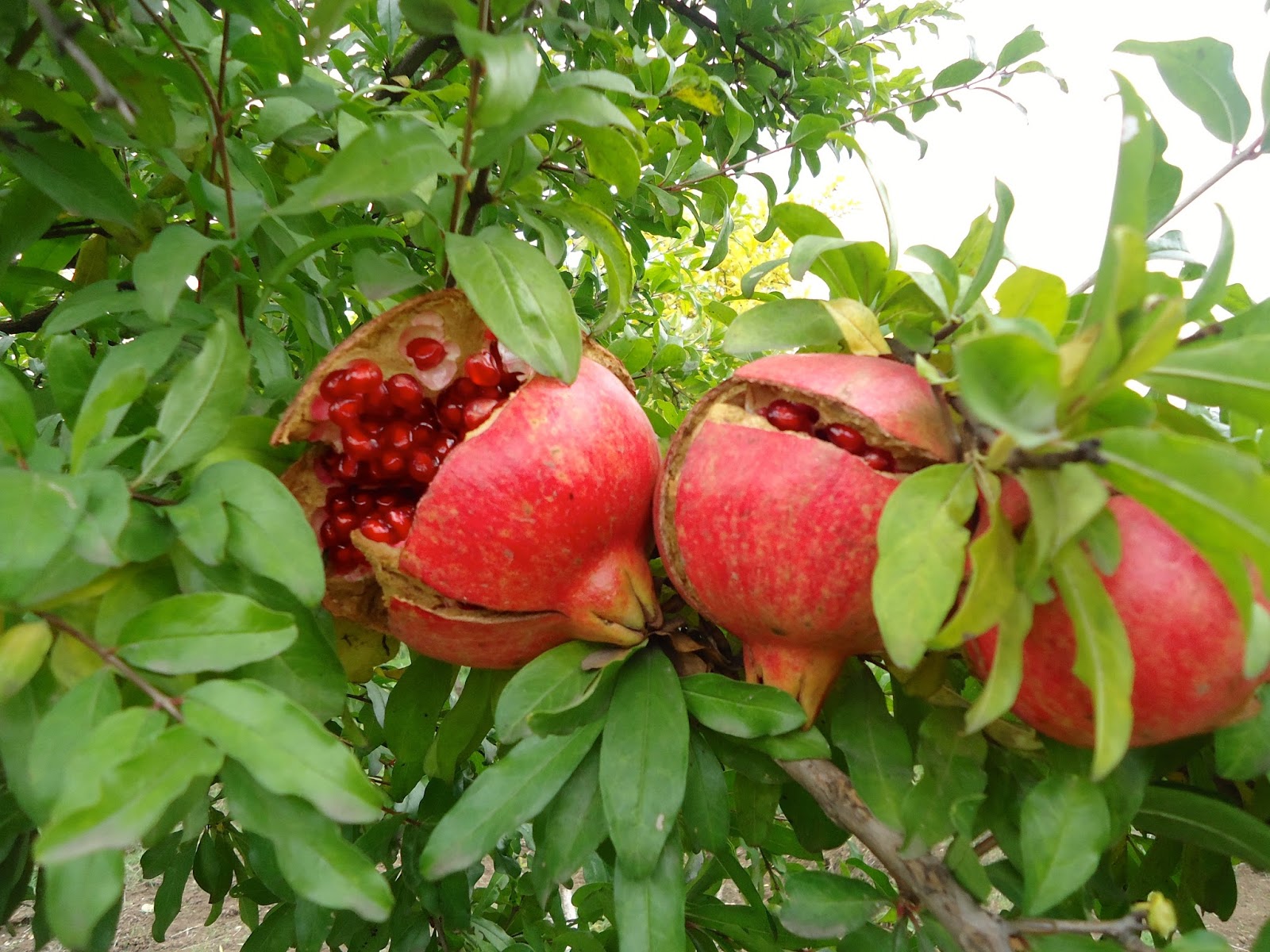
"In Shaili, we met with the pomegranate orchardist Armen. He told us that he only cultivates two of the most widespread cultivars which he referred to as Gyulasha 1 and Myursa. They probably correspond respectively with "Gyulasha Armenia" and "Bala-Myursal", the latter meaning "Cherry of Myursal" and being referred to in Ashton's volume on pomegranates. Gyulasha Armenia has large bushes with standing upright branches going up to 5 meters. The fruit is round and flat with a convex base and a wavy peak. It has thin, flexible, smooth and shiny rind. It tastes sweet-tart. Gyulasha Armenian is very abundant and in a season, it produces nearly 20 kg harvest per tree. Here are some Gyulasha Armenia bushes.


Gyulasha Armenia is the longest keeping cultivar in Artsakh. People keep the fruits up to one year and use them for various purposes. Orchardists keep the pomegranates in cellars, but the sellers keep them in fridges. They use this cultivar to produce juice and wine, which is delicious and of high quality.


The second cultivar is Bala-Myursal. It is a very nice and juicy one, maturing at the end of september. However, it is not a long-keeping fruit. The bush has weak thorny branches. The fruit looks round, dark red and bright. It tastes sweet and it is delicious. One bush of Bala-Myursal produces nearly 25 kg in a season.


We then continued our explorations and met another orchardist from Shaili: Taron. He came to Shaili from the Armenian town of Vanadzor and planted pomegranate orchards. He cultivates more specifically Bala-Myursal and Gyulasha Red pomegranates.


Here is Tarom's son, Aram, a very cute boy who helps his father in the pomegranate orchards."

Pomegranate orchards in Askeran (3)


"Then, we got to Askeran. There are many pomegranate orchards whose owners sell fresh fruits in Yerevan and elsewhere in Armenia, keep them in fridges to sell them during winter time or make very tasty wine out of them. Artsakh's soil is very good. Actually, its other name, i.e. Karabakh, means in Turkish "black" ("kara") "garden" or "soil" ("bakh"). Water availability, in particular through government programs, contributes further to making it an excellent place to grow pomegranate bushes. We visited one of the largest orchards there.


Various cultivars are grown in Askeran orchards. Many of them seem unnamed. The orchardists said that they simply collect the best types they come across. Here is a very sweet one: Red Sweet. The bush of Red Sweet is large, with dense vegetation. The fruit is red, with slight green color. The juice is very abundant and wine-colored. It is a delicious type and is suitable for conservation purposes too."


dimanche 14 février 2016

Luxuriance de la Horta (Janvier 2016)


Ce mois de janvier a battu des records de pluviosité au Monte. On a sans doute tourné autour des 90 mm. Alors, quand vient un rayon de soleil, c'est l'impression de luxuriance qui domine à la Horta, et ce malgré des petites gelées au sol le matin. Une fois dégagées les bases des arbres, envahies de mauves et de rumex, l'impressionnante croissance des artichauts plantés au printemps et des tagasaste plantés en août n'en devient que plus visible. Les alignements du verger commencent à prendre forme...


Première ruche


Durant la seconde moitié du vingtième siècle, la Horta avait son rucher à l'abri d'un petit toit, du côté extérieur de son mur oriental. Alors, quand j'ai rencontré Marco par hasard chez le serrurier de Reguengos cet été, je me suis dit que le retour des abeilles était peut-être pour bientôt. La première ruche de Marco est arrivée à la fin de l'automne et il semble que les abeilles se plaisent en cette fin janvier. Reste à passer le premier grand test: l'été!

samedi 13 février 2016

Le drone d'Alexandre


Il y a quelques jours, Alexandre, de TerraDrone, est venu avec son drone prendre 257 photos d'une partie du Montado das Cebolas. Il les a assemblées, puis en a tiré une série d'informations, et spécialement une carte topographique reprenant les courbes de niveau mètre par mètre, outil indispensable pour mettre en place une gestion des l'espace inspirée de la méthode australienne keyline. Voici donc quelques-unes de ces photos, où vous découvrirez notamment l'état d'avancement des plantations d'arbres fruitiers paillés à la Horta et autour du Monte.


Alentejano wickets


What is special about alentejano wickets is that they have five or six rather than three stumps. Another specific feature is that their main purpose is not to be part of a cricket game. Alentejano wickets are there to help making the life of wild steppe birds easier, to prevent them from being systematically blocked by sheep fences. Fences are needed to manage grazing pressure. And with this system suggested by the ICNF, we are trying to reach a balance with what steppe birds need. We remove the bottom half of the grid between the stumps, to allow them to cross without having to fly. Now, don't be surprised if, at some point in the future, you cross some Sainte-Marie-La-Mauderne cricket players...

Cacos de vidro (Estremoz)